Training & Education I
Ethical and Scientific Excellence in Laboratory Science
LAM provides a dual-track professional development system, recognizing that the competencies required for veterinarians and non-veterinary scientists differ but ultimately converge on high-quality, responsible animal research.
1) Non-Veterinarian Track — Laboratory Animal Science Specialist
This track cultivates professional Laboratory Animal Science Specialists, providing non-veterinary trainees with the full scientific and technical foundation required for high-quality animal-based research.
Participants from biology, biomedical science, toxicology, engineering, and related fields are trained to become experts in laboratory animal biology, welfare, experimental methodology, and research integrity.
Training includes:
– Core laboratory animal biology: species differences, physiology, behavior, developmental stages
– Experimental pathology fundamentals: mechanistic interpretation of disease processes in laboratory animals
– Experimental procedure proficiency (supervised surgical & non-surgical techniques)
– Toxicology & safety assessment with GLP/OECD principles
– Husbandry and environmental management essential for SPF, ABSL-2/3, and specialized facilities
– Welfare and the 3Rs: refinement of procedures, pain/distress assessment, humane endpoints
This pathway enables non-veterinary trainees to become professional laboratory animal specialists, contributing essential expertise to ensure that research involving animals is ethical, reproducible, and scientifically robust.
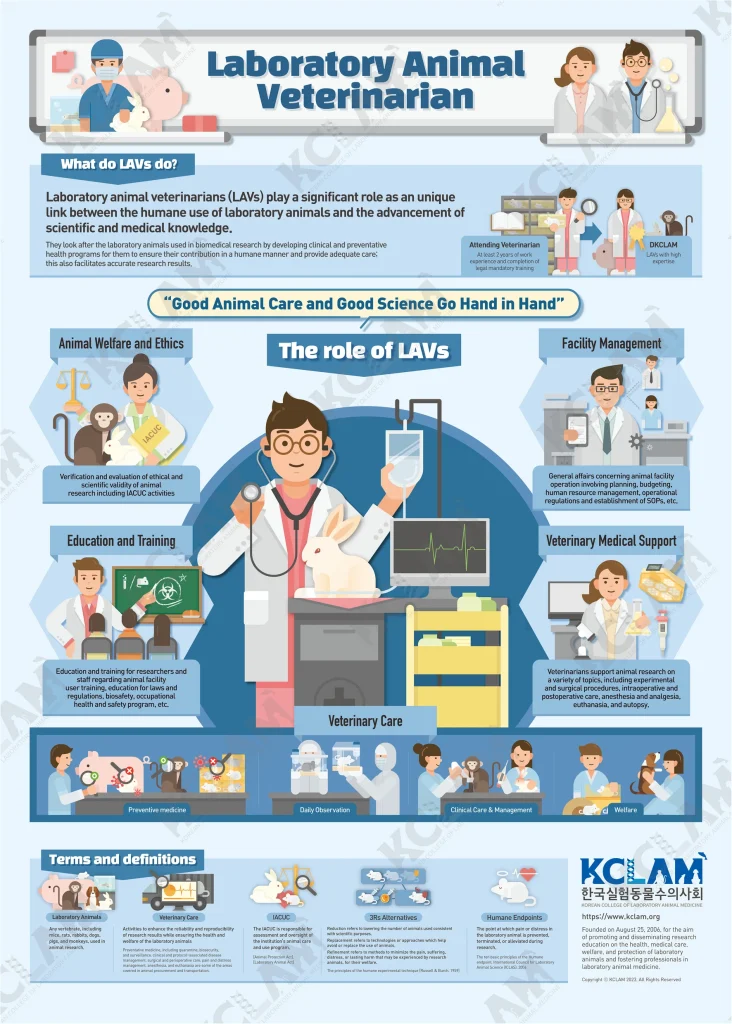
2) Veterinarian Track — Certified Laboratory Animal Veterinarian (DKCLAM)
Korea uses approximately five million research animals each year. Their scientific and ethical use requires veterinarians who not only understand experimental biology but also possess advanced competency in animal welfare, ethics, and clinical care.
The goal extends far beyond operational management or medical care; it is to cultivate scientific leaders who can interpret and generate mechanistic insight from animal models in biomedical research and to train veterinary scientists who can bridge clinical judgment with experimental rigor.
DKCLAM certification, established under the Korean College of Laboratory Animal Medicine (KCLAM), represents the highest national qualification for laboratory animal veterinarians.
KCLAM is a member of IACLAM, collaborating with ACLAM (US), ECLAM (Europe), JCLAM (Japan), and others — ensuring global harmonization of standards.
Through this track, veterinarians are trained not only as clinicians but as facility leaders, capable of overseeing health management, ethics governance, biosafety, and translational research support.
They also develop the scientific competence necessary for mechanistic discovery and for evidence-based refinement of animal models.