1. Why Immunotherapy Is Still Inaccessible in Companion Animals
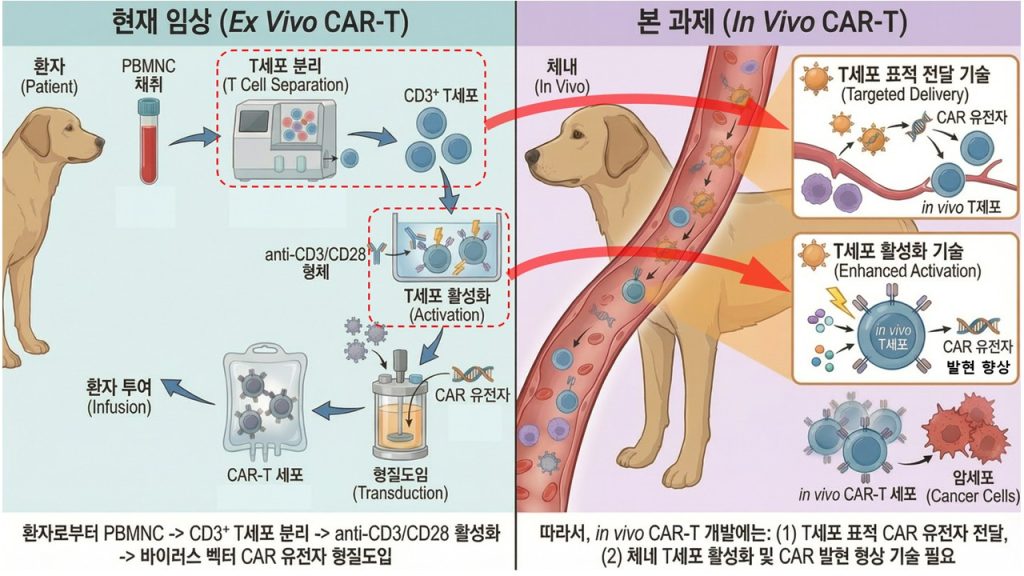
Despite the high incidence of cancer in companion animals, advanced immunotherapies remain largely unavailable. Current approaches such as CAR-T rely on ex vivo cell engineering, making them costly, complex, and impractical in routine veterinary settings.
What is needed is a fundamentally different approach:
an immunotherapy that is accessible like vaccination,
affordable for pet owners, and scalable in clinical practice.
To address this, we develop a next-generation strategy based on:
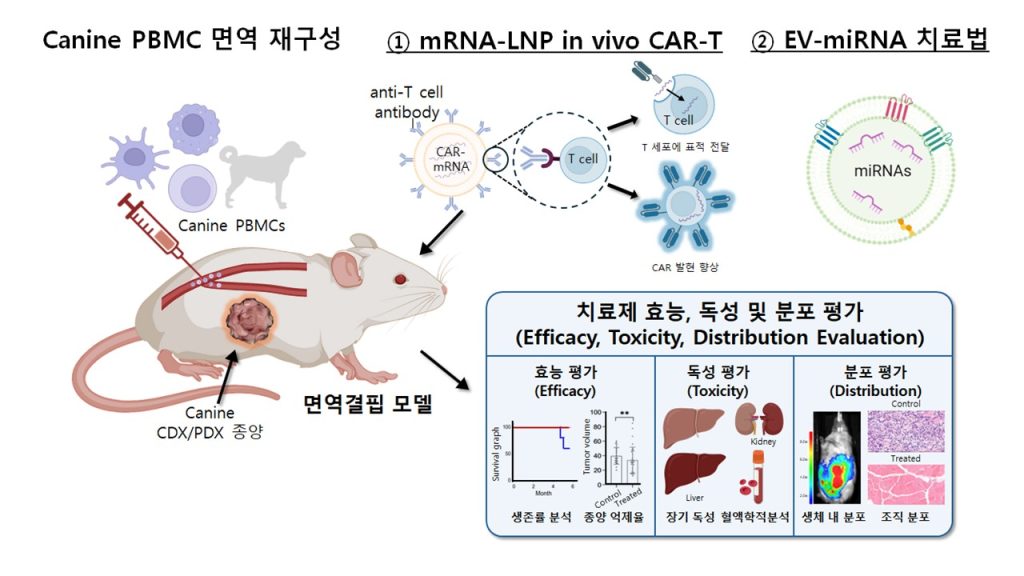
- – In vivo CAR-T using mRNA-LNP delivery (Collaboration with SNU, Prof. Byung-Soo Kim)
- – Extracellular vesicle (EV)-mediated modulation of tumor microenvironment
This combination enables a simplified, cost-effective, and clinically applicable immunotherapy platform (Collaboration with SNU, Prof. Kyung-Rok Yu).
2. A Paradigm Shift in Animal Modeling
Developing therapies for companion animals has long relied on an inherent paradox:
the use of dogs as experimental subjects.
To overcome this limitation, we establish a next-generation preclinical platform based on:
companion animal–derived disease modeling in rodent “avatar” systems
By integrating:
- – Canine tumor–derived PDX/CDX models that preserve tumor heterogeneity
- – Canine immune–relevant (caninized) modeling systems to recapitulate immunotherapeutic responses.
-
- Thus, we establish preclinical platforms that faithfully reflect clinical disease biology, while minimizing the direct experimental use of companion animals.
3. Clinically Integrated Animal Medicine
Successful translation requires more than modeling—it demands real clinical integration (Collaboration with EULJI Univ, Prof. Geon A Kim).
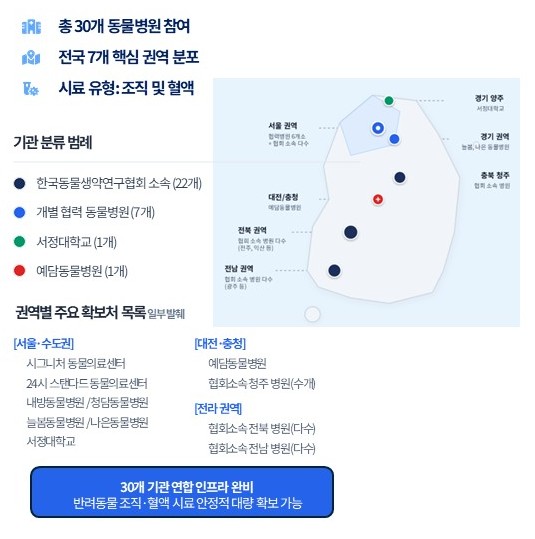
We therefore establish a nationwide collaborative network:
- – Multi-center veterinary hospitals for sample acquisition and validation
- – Standardized pipelines for ex vivo and in vivo testing
- – Direct linkage between clinical cases and experimental models
Through this system, we position laboratory animal medicine not as a separate discipline, but as: a field that directly connects preclinical modeling and real-world clinical practice